

What If?


March 18, 2026
by
Marianne Seggerman (she/her)
What would Christianity look like if Jesus wasn’t crucified? Today’s reflection invites us to examine this week’s readings more closely and reconsider what we may picture when we read the Bible.
March 22, 2026: Fifth Sunday of Lent, Year A
Ezekiel 37:12–14
Psalm 130:1–8
Romans 8:8–11
John 11:1–45
What If?
A reflection by Marianne Seggerman
This week’s gospel is the account of Lazarus’ resurrection from the dead. Lazarus, a close friend of Jesus, has died; despite the body’s decomposition, Lazarus returns to life after Jesus prays to God. Today’s first reading – from Ezekiel – may be construed as foretelling the resurrection not of Jesus, then, but of Lazarus: “know that I am the Lord, when I open your graves and have you rise from them” (37:13). I am tempted, as I often am in writing these reflections, to ask: what was the actual event which generated this story? Or is that an irrelevant concern?
Instead of speculating about exactly what happened, I will reflect on other parts of the readings. I could have simply dismissed the account as symbolic, then sheepishly abrogated my duty by admitting I have no idea what the spiritual significance of the account is. I will therefore focus on other parts of the passage.
The first of these is the passage where the disciples caution Jesus about returning to Judea to visit Martha and Mary – and later, of course, Lazarus (Jn 11:8). “Rabbi, the Jews were just trying to stone you, and you want to go back there?” Whoa. Imagine what would happen if they were successful. How different would things be if Jesus met His death not on a cross, but by being pelted with rocks? Would Christianity still take hold? I think so; the resurrection of Lazarus comes towards the end of His three year ministry, and he had spent those three years travelling and teaching.
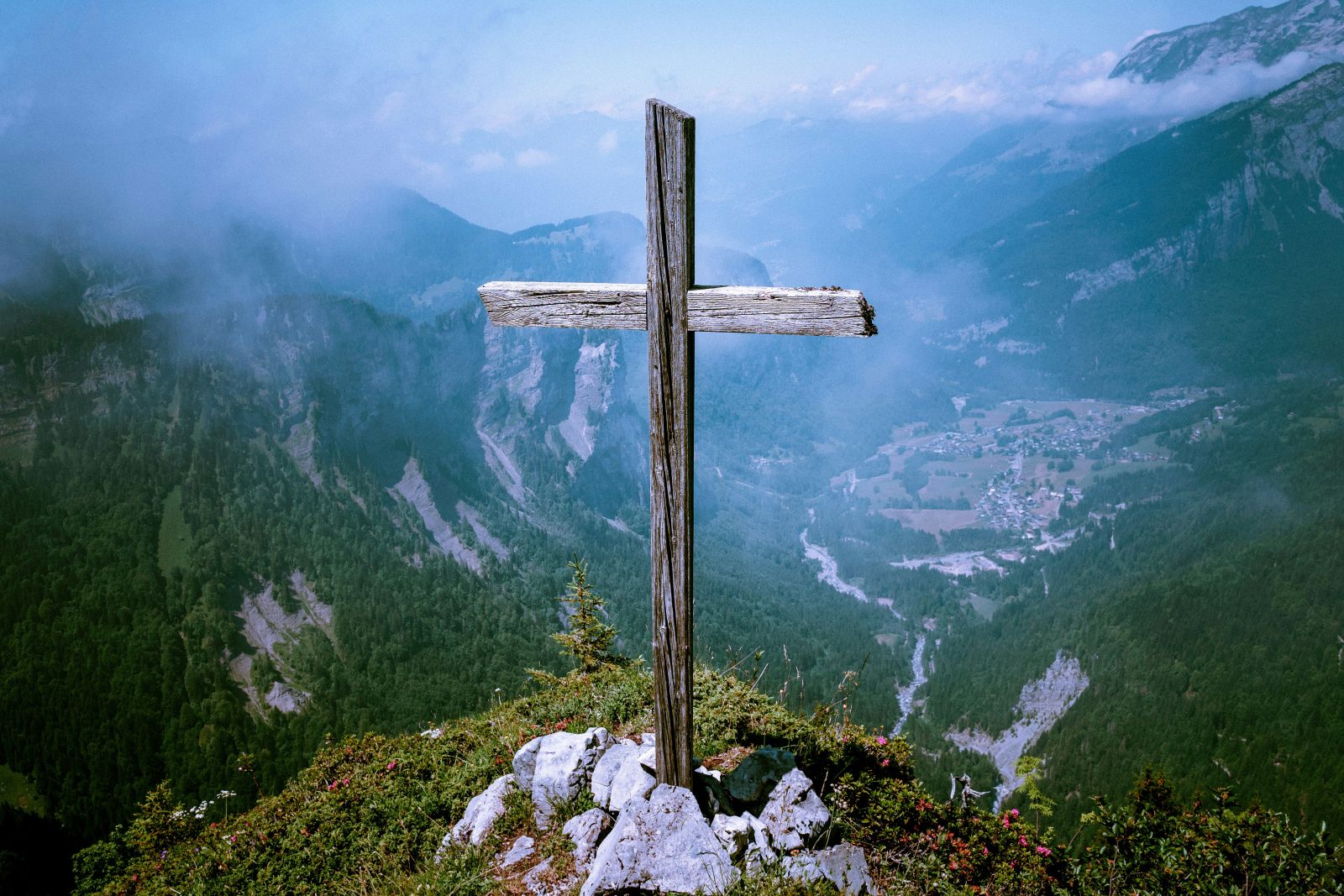
I think about how much of Christianity comes from Jesus having been crucified. Every church I have ever attended or visited over 6 decades – well every Catholic church, that is – has had a representation of Jesus on the cross hanging front and center over the altar. It is probably a requirement, it’s so ubiquitous. Many Catholics and Christians of other denominations wear crosses around their necks as a pendant from a chain – from the young men at a pizzeria in Queens, New York, to maids in those British detective dramas I see so often on television.
It’s not just the image of the cross itself, though. The blood from the Eucharist at Mass comes from the wound in Jesus’ side, where the Roman soldier stabbed him to put Him out of His misery. I can only imagine how different the liturgies would be if Jesus didn’t die on the cross. The cross is such a central focus of Christianity, and so much derives from that image.
The second point is that Jesus understood what a family of choice was. Jesus' relationship with His actual family was, by all accounts, strained. His mother supported His ministry a thousand percent, but his younger siblings were initially skeptical. I really can’t blame them. Their father Joseph is (probably) dead at this point, which makes Jesus the eldest son – the head of the household in a very family-oriented culture. They can’t criticize His choices. He is stirring up the antagonism of the powers-that-be – both religious and political forces causing them problems – and there is nothing they can do about it.
So, who does Jesus turn to for companionship and moral support? Three siblings eking out a living together, none of them married. Are they too young to marry, any of them? Or are they widowed? Divorced, even? I can see a man threatened by Mary’s thirst for knowledge causing a husband to reject her, sending her back to her siblings.
When Jesus hears that Lazarus has died, He drops everything and rushes back to be with Martha and Mary, even at the threat to His own life. That action was typical of what we do for our chosen family; we often feel as responsible for our chosen family as those we happen to be related to biologically – if not more.
There is a book I mentioned in an earlier reflection which is a great influence on my writing: You Got to Be Kidding! by Joe Wenke, which could just as easily be shelved in the humor section as in the religion section. Inspired by Wenke’s insight, I noticed that, unlike Lazarus, there was no mention anywhere in Scripture of the effects of decomposition on the Risen Christ. I guess if you are rich, like Joseph of Arimathea, you can afford a burial site with climate control (or what passes as climate control in 33 CE) – paying a lot of men to move a big stone so that it makes the cave air-tight!

Marianne Seggerman joined the chapter of Dignity New Haven around 30 years ago. That chapter is no longer alas but she continues to attend the biannual conference. In her day job she is a computer programmer living (and for the moment working) in Westport Connecticut. She is in a long-term relationship with a person raised Jewish who converted to the Mormon faith.
Thank you for reading our Breath of the Spirit reflections.
Please consider making a donation to help support our mission. Thank you!

.svg)


.svg)
