

A Single Step: On Labyrinths and Life


January 28, 2026
by
Carter Fahey (he/him)
How do we move forward when the world is overwhelming? Today’s reflection considers the value of small actions, trusting that, together with God and our communities, these steps can help us bring about meaningful change.
February 1, 2026: Fourth Sunday in Ordinary Time
Zephaniah 2:3; 3:12–13
Psalm 146:6–10
1 Corinthians 1:26–31
Matthew 5:1–12a
A Single Step: On Labyrinths and Life
A reflection by Carter Fahey
A few years ago I went on a silent retreat in the Welsh countryside. It was an uncertain time in my life; I was in the process of finishing my master’s, preparing to be received into the church, and generally just trying to figure my life out.
I spent a lot of that week wandering–through the silent halls of the old Victorian building, through open fields sparsely populated by herds of sheep and cows, down winding country roads, and up into the Welsh mountain with only pheasants for company, whose sudden cacophony of wings often interrupted the quiet peace of the late-winter fog.
Having just made the journey up from Oxford, where the academic calendar forces students to go full-tilt for eight weeks at a time before collapsing into an untidy heap at the beginning of break, the lack of activity was unsettling. Suddenly, I didn’t know what to do with myself. Nothing felt productive. Everything was unfamiliar, destabilizing, and, to be quite honest, frustrating. So much of my life was (and is) built on doing that when I was forced to stop–not just a self-care break of an hour or two, but a total removal from the chatter and bustle of daily life–and stand defenseless before God, the world became a foreign place.
The wandering was a physical manifestation of this turmoil. Unsure what the next phase in my life would be, what choices I would have to make, and which path to turn down, I tried to outrun my restless anxiety by keeping one step ahead, physically and mentally.
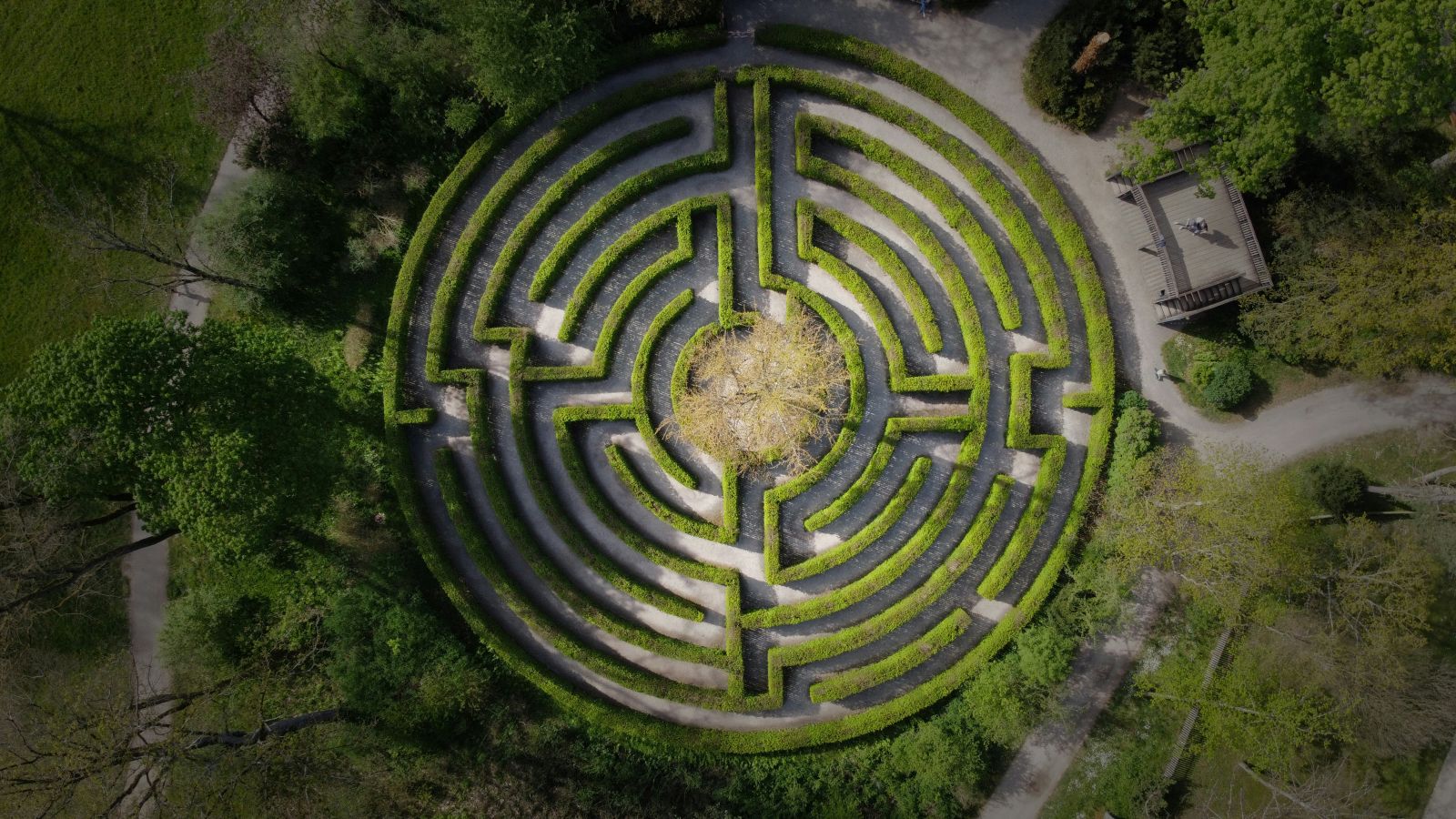
At the beginning of the retreat, we were told that there was a labyrinth in the garden. Initially, I dismissed this as ridiculous. The entire countryside was at my disposal, endless choices each leading to a different scenic vista–why follow some lines on the ground to walk in circles? I could achieve the same results by meditating whilst walking more interesting routes. As the week wore on, though, I became curious, and eventually I stepped into that dizzying pattern of endless turns.
It was shockingly uncomfortable. I felt silly, and the entire exercise seemed pointless. I wasn’t getting anywhere, and the forced path–much like the silence and calm of the retreat itself–was endlessly frustrating.
In the spirit of patience, though, I forced myself to slow down and focus on each individual step. Suddenly, the labyrinth didn’t seem quite so ridiculous after all. Focusing entirely on each step, without worrying about the steps before or the steps that would follow, allowed me to be present–really present–for the first time in a long time.
Maybe it seems like a grandiose conclusion to draw from a gravel path somewhere in the Welsh foothills, but I felt that God was asking me to slow down, let go of my rigid grip on my life, and allow Christ to guide me through the twists and turns of human existence without worrying about the future, trusting that that path would ever closer to God. Instead of an exhausting and impossible list of choices that weighed me down, I just had to focus on the next tiny, trusting step.
For many of us, the world has become an unfamiliar and unwelcoming place. Everywhere we look, we see violence, fear, and uncertainty on the local, national, and international level. My own church community has been shaken by news of abuse. ICE continues to kill senselessly, unchecked and even encouraged by our own government. War seems almost an inevitability.
We cannot sit idly by, averting our eyes from those in pain, shrugging apologetically when our neighbors need us. “Consider your own calling,” the author of 1 Corinthians entreats–Christ calls us to more than this! Things need to change, and we are the ones who must take action.
What’s the point of walking in circles when we know where we want to go?
Often, when I am feeling overwhelmed trying to make sense of everything, struggling to catch even the smallest glimmer of God in a world which seems dominated by fear and pain, I think of a bit of Rilke which I came across a few years back (trans. Edward Snow):
I was scattered; the pieces of my “I”
were doled out among my adversaries.
…
In back alleys I found shards of myself,
sifting through litter and old glass;
with my half-mouth I stammered at you–
at you, eternal in your equanimity.
How I lifted my half-hands
up to you in nameless pleading,
that I might discover again those eyes
with which I once beheld you.
This world and its demands can tear us apart, shattering everything we hold closest to ourselves. There is so much that needs doing, so much that demands our attention, that we are overwhelmed and paralyzed by sheer volume, and our littleness in the face of it all. We wander amongst the vast landscape of choice and action, but our steps seem to take us nowhere at all.
How do we find God amidst this?
Of course the answer is not to retreat and do nothing. But if each individual tries to do everything themselves, we will all find ourselves burnt-out, exhausted from running in all directions.
Instead, we must discern the next step on the path, slowing down to let God guide us. Much like walking the labyrinth, our path forward might not be obvious, but there will always be one more step. It will look different for everyone. Perhaps today it means mourning those lost to violence, striving for righteousness in our communities, showing mercy to our neighbors, working for peace
All of us, though, are called to seek God, “all you humble of the earth… seek justice, seek humility.” One small, trusting step leads to another, and another, and suddenly we will find what we have been striving for all along.

Carter Fahey (he/him) is the Associate Editor of Breath of the Spirit and studied at Oxford. He is a convert and has an interest in doing outreach work to Catholic communities to combat misinformation and create opportunities for community among LGBTQIA+ people.

.svg)


.svg)
